
Why Do We Trust Carbon Steel?
When I released my first batch of Hewn hook knives, I offered my customers a choice of steels: conventional ‘high-carbon’ blade steel (80CrV2), or a modern stainless steel (14C28N). Despite extolling the virtues of the stainless version, the carbon steel knives sold faster.
I had not planned this as an experiment. I was simply using up the 80CrV2 left in my workshop before committing fully to 14C28N. But it revealed a deep-seated trust of ‘high-carbon’ steels over stainless. The result does not tell me that carbon steel performs better. It tells me that, when everything else is equal, people trust it more.
Why?
The received wisdom
Among woodworkers and many toolmakers, carbon steel is commonly considered the proper material for a serious cutting tool. Carbon steel is thought to take a finer edge, hold it better, stand up to hard use and be easier to sharpen. Stainless is for kitchen drawers; carbon steel is for people who know their tools.
This reputation was not invented. Simple carbon and low-alloy steels have several genuine strengths. They usually contain a small volume of relatively small iron carbides, which allows them to take a very fine edge, gives them good toughness and makes them comparatively easy to grind, finish and sharpen. Grades such as 1095, 80CrV2, 52100, O1 and 26C3 can reach ample hardness for a carving knife while being forgiving to heat-treat. They are inexpensive, respond well to forging and can be hardened with simple equipment available to a small workshop.
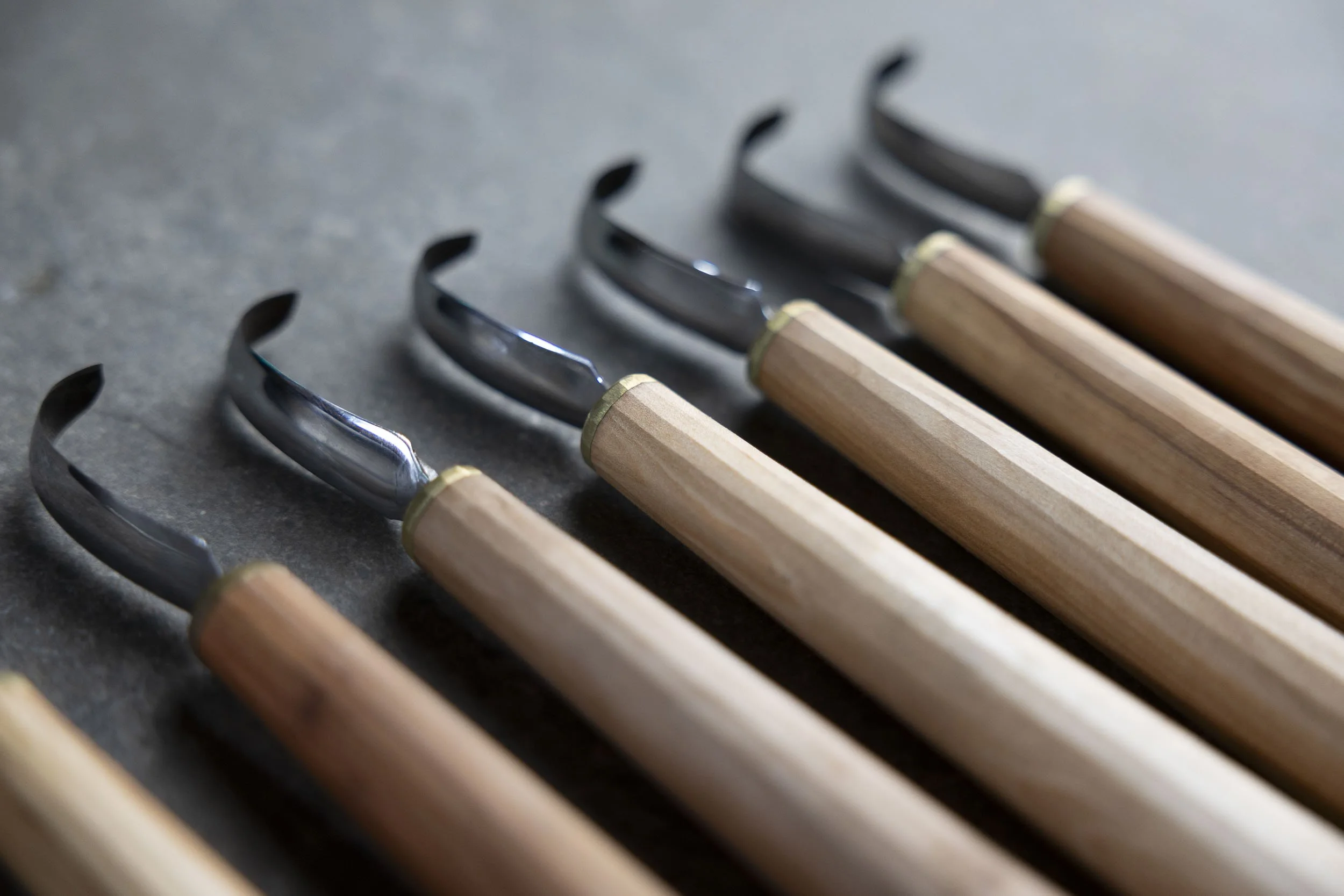
Hewn Hook knives in 80CrV2 Steel
The poor reputation of stainless steel was also based on real experience. Many early stainless knives (1920s-1960s) were heat-treated to relatively low hardness and made with thick, uninspiring geometry. They resisted rust but did not cut especially well. From the 70s onwards, newer stainless steels such as 440C and 154CM could offer substantially greater wear resistance, but achieved it with larger and harder carbides than simple carbon steels, making them harder to sharpen and less tough. Compared with carbon steel tools of the time, stainless steel knives were either too soft or too coarse and difficult to maintain.
This history helps explain several beliefs that are still repeated today: that carbon steel takes a finer edge, is always tougher, is easier to sharpen and holds its edge better. The first three were often true when the comparison was with the stainless steels then in common use. The claim about edge retention is more complicated. Simple carbon steels are easy to bring back to sharpness and can support very fine geometry, both of which can make them seem to remain usefully sharp. But because they contain relatively little carbide of a softer type, their resistance to gradual abrasive wear is generally modest. Many stainless steels will outlast them in controlled slicing tests, although the more wear-resistant steels may demand more work when sharpening eventually becomes necessary.
The more useful distinction, then, is not simply carbon versus stainless. A steel's behaviour depends on its hardness; the quantity, size and type of its carbides; the amount of carbon held in solution; its heat treatment; and the geometry of the finished blade. Corrosion resistance is only one part of that picture. A stainless steel can be soft or hard, tough or brittle, easy or difficult to sharpen. The same is true of a non-stainless steel.
Modern metallurgy has also made the old division much less useful. Powder metallurgy has allowed very highly alloyed steels to contain smaller, more evenly distributed carbides, improving toughness compared with conventionally produced steels of similar composition. Larrin Thomas's comparative carbide and toughness data illustrate both this effect and the broader trade-off between carbide volume, toughness and abrasive edge retention. At the other end of the spectrum are low-carbide stainless steels such as AEB-L, 13C26 and 14C28N. Their carbide structures are much closer to those of simple carbon steels, allowing them to retain the fine edge, high toughness and relative ease of sharpening for which carbon steel is valued, while also providing genuine corrosion resistance.
This does not make carbon steel obsolete. It remains an excellent and often very sensible material, particularly for a maker who forges blades and values simple, economical processing. Nor does it mean that every modern stainless steel is suitable for a spoon knife. Some prioritise extreme wear resistance at too great a cost in toughness and sharpenability. The point is simply that “carbon” and “stainless” no longer tell us enough to predict which steel will make the better tool. We have to compare the particular alloys, at the intended hardness and with the intended edge geometry.
A woodworking preference
This preference for carbon steel seems particularly strong in woodworking. Kitchen-knife makers have long embraced stainless steels, while pocket-knife, hunting-knife and EDC enthusiasts scrutinise individual alloys and often favour modern stainless steels. Even in bushcraft, where carbon steel retains a strong following, stainless steels are generally judged on their particular merits rather than dismissed as a category.
Woodworking has been slower to change. Carbon steel remains associated with serious handmade tools, while stainless steel is still associated with cheaper, mass-produced ones.
Perhaps corrosion resistance seems less important when we picture chisels and plane irons living in dry workshops. Spoon knives are different: they cut wet green wood and travel between sheds, woods and tool bags. For them, corrosion resistance has considerable practical value.
If stainless steel were inherently unsuitable for fine cutting tools, it would not be so widely embraced in the branches of knifemaking most preoccupied with performance. Woodworking may simply be holding on to an assumption that other knife users have already begun to leave behind.
Carbon steel has earned its reputation
None of this is an argument against simple carbon-steels such as those mentioned above.
They are excellent blade steels. They are tough, capable of high hardness, relatively forgiving to forge and heat-treat, easy to grind and straightforward to sharpen. There are good reasons they have become so popular with bladesmiths. I am very happy to put my name on a knife made from 80CrV2, for instance.
Carbon steels also possess qualities that are not easily captured in a technical specification. They are traditional. They acquire a patina. They feel honest and familiar. For a handmade tool used in a traditional craft, that has an undeniable appeal. But familiarity and performance are not quite the same thing.
A patina may be beautiful in some circumstances, but rust is not a performance advantage. Ease of manufacture is valuable to the maker, but it does not necessarily improve the tool for its owner. A material can be traditional, attractive and very good without being the best available choice.
What qualities does a spoon knife actually need?
Before choosing a steel, I looked closely at the steels used by well-known toolmakers in the green-woodworking world. One thing became clear: toughness was generally valued more highly than extreme wear resistance.
That makes sense. A spoon knife has a very fine edge, and that edge is used on a tight curve, sometimes in difficult grain and with considerable force behind it. A steel may resist gradual abrasive wear extremely well but still be a poor choice if its edge is too prone to chipping.
In tool steels, there is a trade-off between wear resistance and toughness. As one increases, generally the other one decreases.
Wear resistance is often increased by forming a greater quantity of very hard carbides within the steel. These resist abrasion and help an edge remain sharp for longer, but they can also provide points at which a crack may begin. As the quantity and size of the carbides increase, toughness generally falls and the steel becomes more prone to chipping.
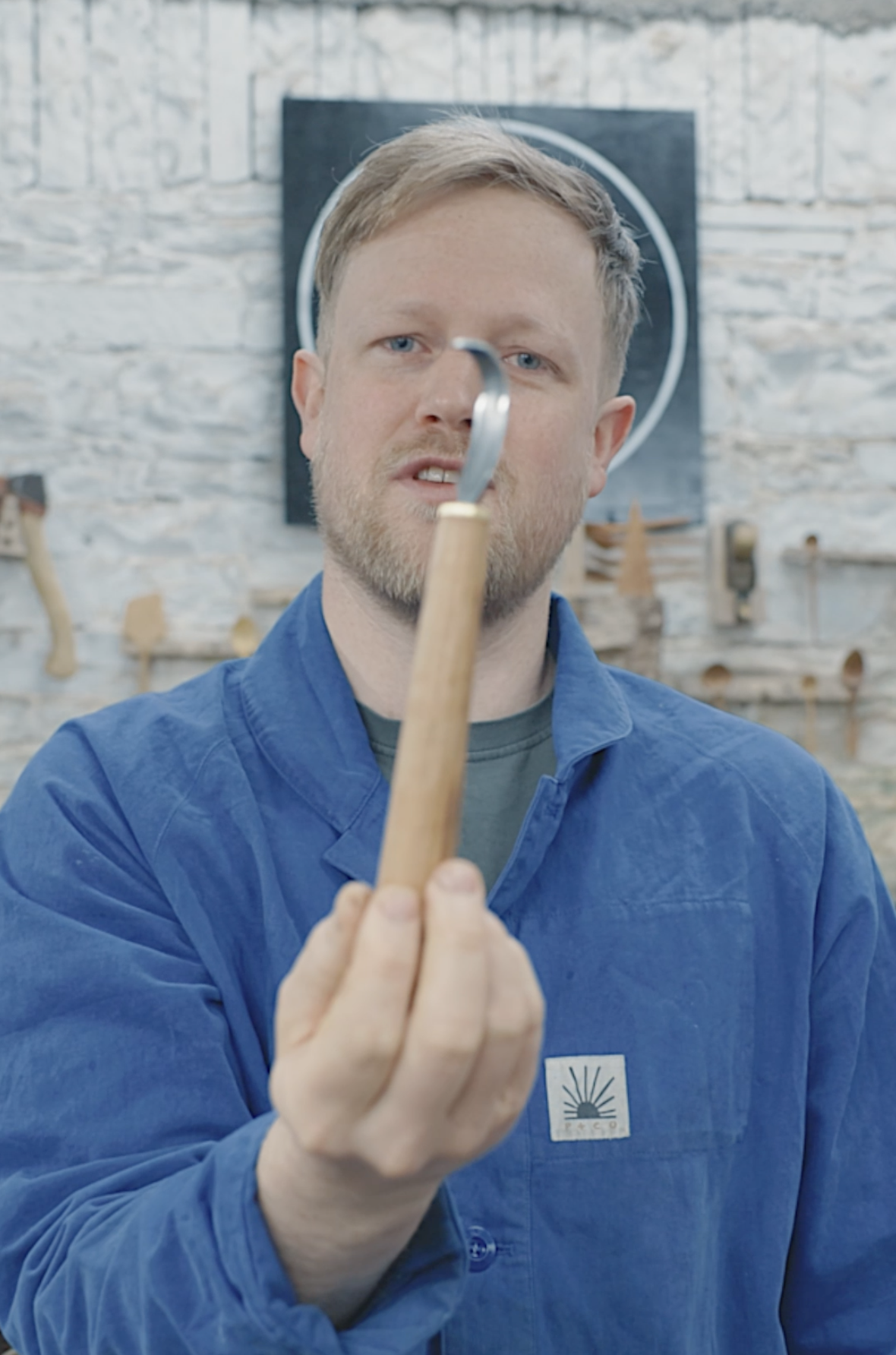
Showing off a hook knife in 14C28N Steel
A tougher steel will generally contain fewer or smaller carbides. Its edge may wear somewhat faster, but it is better able to tolerate stress without fracturing. The challenge is therefore not to maximise either property. It is to find the balance best suited to the tool.
There is also a practical limit to the value of wear resistance in a spoon knife. It does not need to cut miles of cardboard or rope. It needs to take a very fine edge, retain it for a useful length of time and be straightforward to restore when it eventually becomes dull.
I was not looking for the stainless steel with the greatest possible edge retention. I was looking for a genuinely tough stainless steel with a fine microstructure, enough wear resistance to offer a worthwhile improvement, and the ability to take and support the kind of edge required for carving wood.
That search led me to 14C28N.
A different kind of stainless steel
I was initially reluctant to reveal the exact grade of steel I’m using. Choosing it involved a great deal of research and testing, and there is a natural temptation to protect that work. In the end, however, simply knowing the name of a steel does not tell anyone how to make a good knife from it.
14C28N is a nitrogen-alloyed stainless steel developed specifically for knife blades. Alleima, the steel's manufacturer, describes its chemistry as optimised for professional knife applications requiring sharpness, edge stability and corrosion resistance. It is not one of the fashionable, extremely wear-resistant “super steels”, and that is part of its appeal. It has a relatively low volume of small, finely distributed carbides, allowing it to combine high toughness with good edge stability and straightforward sharpening.
Independent testing by metallurgist and knife-steel researcher Larrin Thomas (‘The Knife Steel Nerd’) supports this balance of properties. His comparative tests and ratings place 14C28N among the toughest stainless knife steels, while giving it slightly better abrasive edge retention than simple low-alloy steels such as 80CrV2. His separate review of nitrogen-alloyed knife steels attributes the high toughness of 14C28N to its small volume of very small carbides and nitrides. It also has the considerable advantage of genuine corrosion resistance.
This is the important point: becoming stainless does not require giving up the qualities for which carbon steel is rightly valued.
For a spoon knife, 14C28N offers a particularly useful combination. It takes a very fine, keen edge. It has the toughness and fine structure needed to support thin geometry. It offers a worthwhile improvement in wear resistance without becoming tiresome to sharpen. And it is vastly less susceptible to corrosion than 80CrV2.
That last quality is not merely cosmetic. Green wood is wet, and some woods, like oak for instance, can be surprisingly corrosive.
The particular annoyance of a rusty spoon knife
Anyone who owns carbon-steel tools probably knows the feeling of picking up a knife and discovering that it has developed rust since it was last used. It is annoying on any tool, but particularly so on a spoon knife. A straight blade can be laid on a stone and cleaned up relatively quickly. A hook knife has curved cutting surfaces and a more complex geometry. Removing corrosion is a pain!
The working conditions of green woodcarvers make this more likely. Many of us work in a damp shed, a lean-to, or a temporary shelter in the woods, not a warm and dry workshop. Temperatures rise and fall, condensation forms, tools are carried outdoors, and green wood is wet! Some woods, like oak for instance, are surprisingly corrosive too. Even if, like me, you do have a nice workshop, permanently damp conditions (and buildings!) in Ireland make corrosion a part of a woodworker’s life.
Oiling carbon steel certainly helps, as does careful storage but my ‘carbon’ tools all eventually become rusted unless I’m regularly using them.
There is a tendency to treat the maintenance demanded by carbon steel as part of the romance of owning a traditional tool. Sometimes it is. Watching a patina develop can be very satisfying. Discovering rust on a finely sharpened edge is considerably less romantic.
14C28N is corrosion-resistant rather than corrosion-proof, and it should still be treated with reasonable care. But for ordinary use, I essentially don’t have to worry about corrosion. What a great feeling! For a spoon knife used on wet wood, often in a damp and unheated workspace, I regard that as a meaningful quality-of-life improvement.
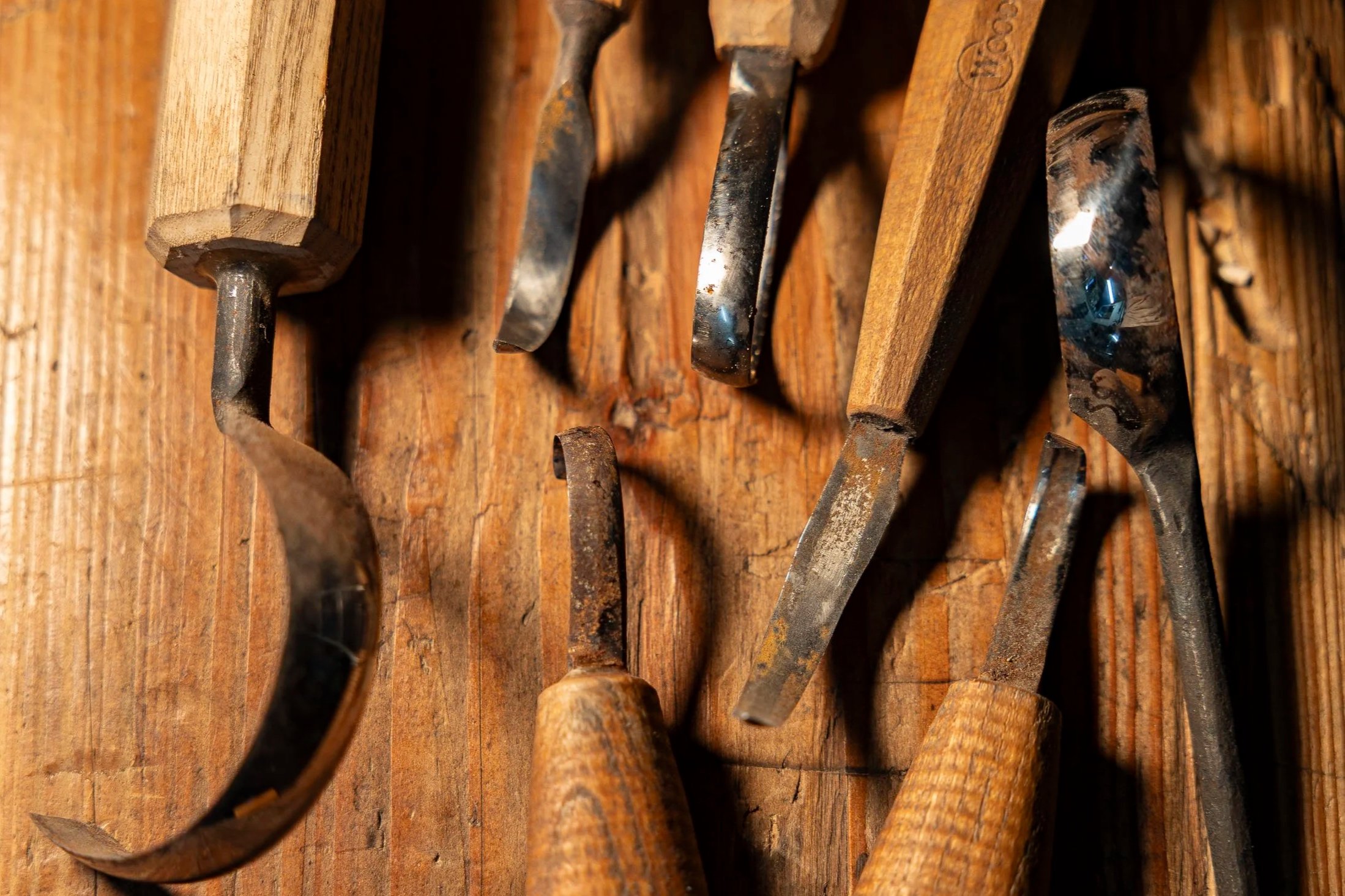
Rust on high-carbon spoon carving hook knives. A constant pain in my ….
Is stainless steel harder to sharpen?
As discussed earlier, another common holdover belief is that stainless steels are much more difficult to sharpen than carbon steels. Again, this confuses a very broad category with the properties of particular alloys.
Some stainless steels genuinely are slow and demanding to sharpen. These tend to be steels designed for extremely high wear resistance, containing a large volume of very hard carbides. Those carbides resist the abrasive used for sharpening for exactly the same reason that they resist wear in use. Some highly wear-resistant non-stainless steels are equally difficult to sharpen.
It is not corrosion resistance itself that makes a steel difficult to sharpen. Hardness matters, but so do the quantity, size and type of carbides in the steel—and the abrasive being used. A fine-grained stainless steel with a modest carbide volume can be considerably easier to sharpen than a highly wear-resistant steel, whether that second steel is stainless or not.
14C28N was attractive to me partly because it avoids this problem. It has enough wear resistance to improve edge retention, but not so much that sharpening becomes an ordeal. I sharpen mine with ordinary aluminium-oxide abrasives and have found it no more troublesome to maintain than the carbon steels I use. For a carving tool, that balance matters far more than achieving the highest possible result in an edge-retention test.
Is it simply better?
For this particular tool, I believe 14C28N offers the better overall combination of properties.
That is not the same as saying that every stainless steel is better than every carbon steel, or that a steel grade can be judged independently of everything else. Knife performance also depends on hardness, heat treatment, edge geometry and intended use. Change any of those and you may change the result.
The choice of steel certainly cannot rescue a poorly designed blade. The geometry of a carving knife probably affects how it cuts more than the name stamped on the steel. A beautifully heat-treated piece of expensive steel can still make a bad knife.
But when the geometry and heat treatment are right, 14C28N gives me everything I want from a spoon-knife blade. When compared with the commonly used simple carbon steels (1095, O1, 52100, 26C3), it gives a fine edge, higher toughness, slightly better edge retention and excellent corrosion resistance. And importantly, I can sharpen it with ordinary aluminium-oxide abrasives, just as I sharpen my carbon-steel tools.
I have used both versions extensively. I cannot find a practical advantage that the 80CrV2 version offers the person carving with it. The stainless version does, however, cost me more and make my job considerably harder.
That may help explain why it remains unusual.
Who pays for the difference?
High-alloy stainless steel is more expensive to buy. Luckily, Hook knives are small so the extra cost of the steel itself is minor and is not reflected in the price of the knife.
It is more demanding to forge, considerably more resistant to grinding and much less forgiving during heat treatment.
80CrV2 and other high-carbon steels can be heat-treated using comparatively simple equipment and methods, although careful control will always produce a better and more consistent blade. Bringing out the best in 14C28N requires accurately controlled temperatures, protection from oxygen, an appropriate quench and sub-zero treatment. Small errors can prevent the steel from reaching its potential.
Looking at how other knifemakers explain their preference for carbon steel, the same reasons recur: it is cheaper, easier to forge, simpler to heat-treat and faster to grind. It also suits traditional techniques such as forge welding, patterned Damascus and differential hardening, and many makers and customers simply value the patina, history and character it acquires. Those are all legitimate reasons to choose it. But they are not the same as proving that carbon steel makes a better-performing finished knife. Claims that it is inherently sharper, tougher or easier to sharpen usually come from comparisons with older or highly wear-resistant stainless steels, rather than with fine-carbide grades such as 14C28N. Over time, I suspect the advantages carbon steel offers the maker—and its strong association with traditional craftsmanship—have become entangled with assumptions about the performance experienced by the user.
In other words, most of the disadvantages of 14C28N are experienced by me. Most of the advantages are experienced by the person who buys the knife.
This creates an odd situation. A maker can choose a less expensive steel that is easier to forge, grind and heat-treat, and customers may actually prefer it because its name and appearance are more strongly associated with quality.
There cannot be many industries in which making a product more difficult and expensive to produce makes it harder to sell, but tool making may be one of them.
Steels commonly used in spoon knives
I don't know of any other well-regarded toolmakers using a stainless steel in their hook knives. The highly regarded makers of hook knives seem to prefer one the following simple carbon steels: O1, 5200, 80CrV2, or 26C3. Another prominent maker cites an unnamed high-alloy non-stainless steel. The one prominent exception is Morakniv who, In recent years , they have begun to make their hooks from a stainless steel.
Morakniv's own guide to woodcarving knives describes carbon steel as easy to sharpen with good edge performance, while presenting stainless steel as low-maintenance and capable of long-lasting sharpness. Its stainless hook knives demonstrate that stainless steel is not entirely absent from spoon carving. However, those knives occupy a different part of the market. They are inexpensive, mass-produced tools and are generally not regarded as offering the geometry or performance of the best specialist handmade hook knives.
That association may unintentionally reinforce the existing belief: inexpensive spoon knives are stainless, while serious handmade tools are carbon steel.
But that is a difference in the design and manufacture of the complete tool—not an inherent limitation of stainless steel. There is no reason a stainless blade cannot also be forged, finely ground, carefully heat-treated and given excellent carving geometry.
It simply requires the maker to decide that the additional trouble is worthwhile.
When folk knowledge becomes a rule
Traditional crafts depend heavily on knowledge handed from one person to another. Most of that knowledge is immensely valuable. It prevents every generation from having to discover everything again from first principles. But inherited knowledge can also outlive the circumstances that created it.
“Carbon steel makes the best carving tools” may have been a very useful rule when the alternatives were soft stainless steels with poor edge geometry. It is far less useful now that steels such as 14C28N exist, and precisely controlled kilns and sub-zero treatments are available to small-scale makers.
The persistence of the rule is understandable. Carvers cannot be expected to study metallurgy before buying a knife, and there is an appealing directness to carbon steel. It is familiar, proven and connected with the history of the craft.
I am not trying to persuade anyone that liking carbon steel is wrong. It’s cheap and easy to work with and does a great job but on the other hand, rust on my tools is a constant pain in my neck. And there is an alternative that is not only corrosion resistant, but actually performs slightly better too!
My little accidental experiment showed me which material people instinctively preferred. It did not tell me which knife they would prefer after using both.
That is the more interesting experiment.
My suspicion is that attitudes will change slowly—not because of claims made in a product description, but because people use these knives, sharpen them, carve wet wood with them and discover that the stainless blade takes an excellent edge, holds it well and asks for very little in return.
Carbon steel has earned its reputation over a very long time. Modern stainless steels will have to earn theirs too.
I am happy to give them the opportunity.
Sources and further reading
Alleima, 14C28N knife-steel overview: the manufacturer's discussion of edge stability, microchipping, edge rolling and resharpening.
Thyssenkrupp Steel, 80CrV2 product information: official composition, applications and supplied mechanical properties.
Larrin Thomas, Carbon vs Stainless Steel in Knives: the historical origins of the debate and comparisons of carbide structure, toughness, sharpening and forgeability.
Larrin Thomas, Toughness, Edge Retention, and Corrosion Resistance: comparative experimental data and an explanation of the carbide-mediated trade-off between toughness and wear resistance.
Larrin Thomas, How to Heat Treat 80CrV2: experimental toughness, wear-resistance and heat-treatment results.
Larrin Thomas, Nitrogen-Alloyed Knife Steels: carbide and nitride structure in steels including 14C28N.
Larrin Thomas, Testing the Edge Retention of 48 Knife Steels: controlled testing and the importance of consistent geometry, hardness and sharpening.
Morakniv, Find the Right Woodcarving Knife: the manufacturer's comparison of carbon, laminated carbon and stainless carving blades.
Met Éireann, Climate of Ireland and climate data: official long-term Irish climate information. :D
